Voices Talk Series Resumes: Mete Hatay as Our First Guest
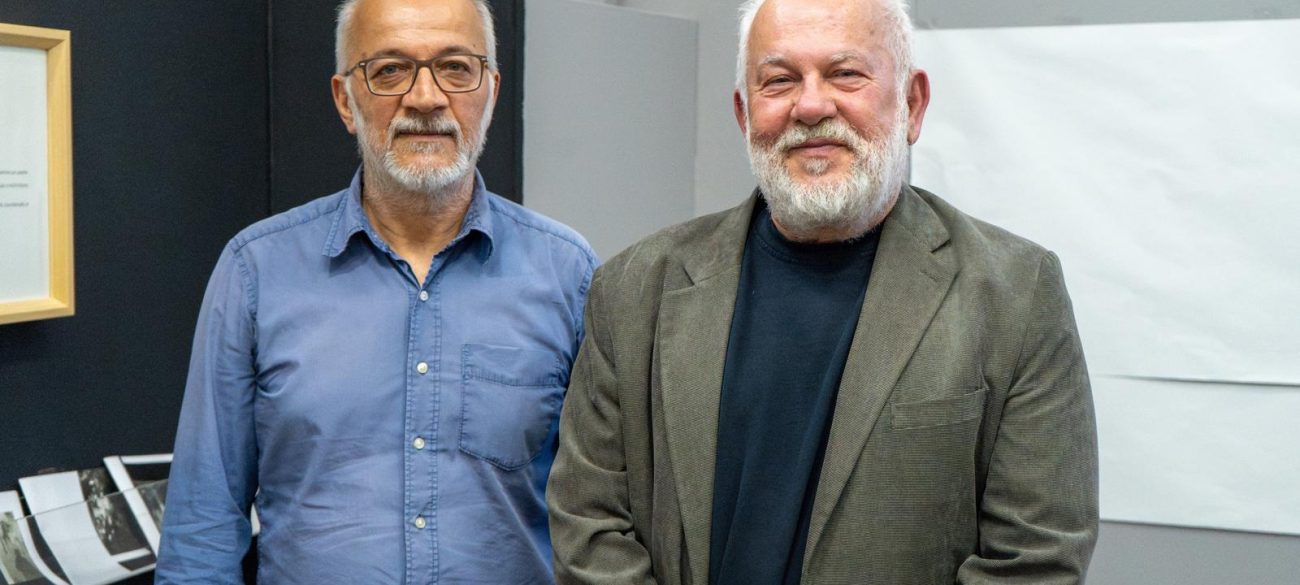
The Voices talk series, organized by the Art and Culture Office of Arkın University of Creative Arts and Design (ARUCAD), has returned after a seven-year break. The first session of the renewed series took place on Thursday evening, April 16, at ARUCAD Art Space, featuring researcher and academic Mete Hatay as the guest. The programme was coordinated by Prof. Dr. Turan Aksoy, a faculty member of ARUCAD’s Department of Plastic Arts, and for the first time this year it reached a wider audience through a simultaneous live broadcast.
Structured in a Q&A format, the session progressed through questions posed by Prof. Dr. Turan Aksoy, with Mete Hatay addressing current issues at the intersection of art, society, and politics. As the discussion expanded with questions from the audience, the event, which saw strong participation, took on an interactive and dynamic character. At the beginning of the session, Hatay’s work in academic and cultural production was also introduced to the audience.
Who is Mete Hatay?
Mete Hatay is known for his work focusing on displacement and property issues in Cyprus, as well as for digital archive projects he has developed in this context and interactive maps he has prepared on migration movements after 1963. Hatay, who was part of President Mustafa Akıncı’s property working group in 2016–2017, also stands out for his publications in numerous local and international academic journals.
In addition to his academic work, Hatay has been active in the field of art and culture. He has been involved in music for many years, composed music for various documentaries, released three albums, and participated in many festivals, including the Onno Tunç Composition Competition. In the field of visual arts, he has held two solo exhibitions and participated in numerous group exhibitions.
Hatay currently continues his work as a senior research advisor at the PRIO (Peace Research Institute Oslo) Cyprus Centre.
Uncertainty is Not a “Situation” but a “State”
In his talk, Mete Hatay emphasized that the most defining feature of today’s world is uncertainty, stating that it has become not a temporary situation but a permanent state. Referring to today’s information environment, he evaluated the situation with the following words: “The intense bombardment of information is undermining information itself. Today, truth and reality are increasingly turning into a field of demagoguery.” In this context, Hatay pointed out that although the amount of information is increasing, its reliability is eroding, and that this situation affects not only information itself but also the way reality is perceived.
Crisis as a Space that Also Fuels Creativity
Addressing the relationship between crisis and art, Hatay said: “We usually interpret crises as destructive, but from the perspective of art, they also open up a space that triggers new forms of production. Because art is never something that exists on its own; we have to think of it together with sociology, politics, and philosophy.” With these remarks, he highlighted the relationship between art and other disciplines.
Hatay stated that art today is evolving into a more hybrid, interdisciplinary, and experimental structure, adding that this transformation is progressing on a more fragile ground alongside global ruptures.
Neoliberal Transformation and the Standardisation of Education
In the talk, Hatay also addressed the effects of neoliberal policies on education: “Education is becoming increasingly uniform. This uniformity eliminates nuances and produces a standardized structure. However, universities should have their own identity, foster critical thinking, and provide a space for democratic debate.” With these remarks, he offered a critical perspective on the current system.
At this point, Hatay emphasized that the quantitative increase in the number of universities alone is not an indicator of development: “You cannot achieve progress simply by opening universities everywhere. What matters is quality education, originality, and the ability to establish a distinct identity.”
During the talk, Hatay also referred to ARUCAD, noting that the university occupies a different position with its focus on art and design, and emphasized the importance of institutions that prioritize critical thinking and production.
A Retreat from Globalization: Is Art Also Affected?
The talk also addressed the transformation in the art world alongside the retreat of globalization. Aksoy stated: “With the decline of neoliberalism, there is a shift toward more repressive regimes. This brings about a process in which art is no longer as global as it once was but is becoming more localized. Whereas there used to be more international exhibitions and circulation, we now see local productions and initiatives that support local work coming to the forefront.”
Taking the floor after Aksoy, Mete Hatay touched on the conditions of artistic production and drew attention to the issue of sponsorship: “Sponsorships are necessary because production requires support, but at the same time, they can become factors that limit the independent and critical nature of art.”
Continuing with contemporary examples, Hatay added: “Today, even raising certain topics is being obstructed. We have seen attempts to prevent references to Palestine at Cannes,” referring to debates on censorship in international art contexts.
The Voices Talk Series will continue under the coordination of the ARUCAD Art and Culture Office, hosting new guests each month and opening up discussions on the relationship between art and current issues.